
Romsey water quality report

On this page
This report gives you information and updates about water quality sampling and testing at Romsey Recycled Water Plant and nearby waterways.
Update - July 2026
On 20 July 2026, Greater Western Water (GWW) began a controlled emergency release of Class B recycled water into Deep Creek from the Romsey Recycled Water Plant.
This carefully managed, last-resort measure is necessary to maintain safe storage levels at the plant and ensure the continued delivery of essential wastewater services to the community.
Read our full statement at Controlled release of recycled water from Romsey plant.
Our sampling and testing approach
We use a risk-based approach to track the performance of the Romsey Recycled Water Plant. This determines how often we sample and test the water quality.
We do our own daily water quality sampling and tests in and around the plant.
During controlled emergency releases, an independent, National Association of Testing Authorities (NATA) accredited laboratory will also conduct sampling and tests at multiple locations. The frequency of independent lab sampling is risk-based, beginning at every three days and increasing or decreasing as results come through.
This strict testing program monitors the plant's compliance with the Environmental Protection Agency’s Victorian guideline for water recycling.
Emergency releases to Deep Creek
We have worked with an external environmental engineering consultant to develop a risk model for Deep Creek's water quality during emergency releases.
The model uses a range of criteria to balance the flow of water in Deep Creek with the amount of water released from the plant, to ensure the appropriate dilution downstream.
We use this model to calculate how much recycled water to release to Deep Creek and when, so we can limit the detectability of our discharge within the target mixing zone boundary (3 kilometres from the release point).
What we test for
We test four main water quality parameters that are established indicators for protecting the environment and human health:
- pH – This is a scale of acidity from 0 to 14. It tells us how acidic or alkaline the water is. More acidic water will have lower pH, while more alkaline solutions have higher pH. Neutral solutions (that aren't acidic or alkaline) usually have a pH of 7.
- Suspended solids - Small solid particles that remain in suspension in water. This is an indicator of water quality. The more solids in the water, the less clear the water will be.
- E. coli - E. coli are common bacteria, normally found in the gut of warm-blooded animals. There are many types of E. coli bacteria, most of which are harmless. However, some types of E. coli produce toxins (poisons) that can cause gastroenteritis (gastro). Read more at betterhealth.vic.gov.au.
- Biological oxygen demand (BOD) - BOD measures the amount of dissolved oxygen used by aerobic microorganisms to break down organic material present in water. It directly affects the amount of dissolved oxygen in rivers and streams. The higher the BOD, the more rapidly oxygen is depleted in the stream, which means there is less oxygen available to aquatic life.
How to read our water quality testing report
The table below shows the quality of recycled water released from Romsey Recycled Water Plant (sampling point 4 on the map below), as assessed by the independent laboratory. We will publish the results as they become available.
2026 testing results
| Date of release | 20-26 July |
|---|---|
| Test | Results |
| pH Levels are between 6 - 9 |
Results not yet available |
| Suspended solids Levels are under 30 mg/L |
Results not yet available |
| E. coli Levels are under 100 org per 100ml |
Results not yet available |
| Biological Oxygen Demand Levels are under 20 mg/L |
Results not yet available |
Data from all sampling points and information about how much recycled water was released will be published when available.
 Green = Pass Class B
Results meet or exceed EPA guidelines for Class B recycled water.
 Orange = does not meet Class B (E. coli) guidelines
Results do not meet Class B guidelines for E. coli. If E. coli results exceed 100 org/100ml on two consecutive occasions, we will stop releasing the water and take additional measures to improve water quality. This is a higher standard than previously required by the EPA and demonstrates our commitment to protecting Deep Creek and the community.
 Red = Fail Class B
Results do not meet Class B guidelines. GWW will pause the release and take additional measures to improve water quality.
Sometimes sampling point results may be impacted by other water or substances entering Deep Creek outside GWW’s control. For example, during heavy rainfall, stormwater from the stormwater drain upstream of the Romsey release point (sampling point 4) may enter the waterway.
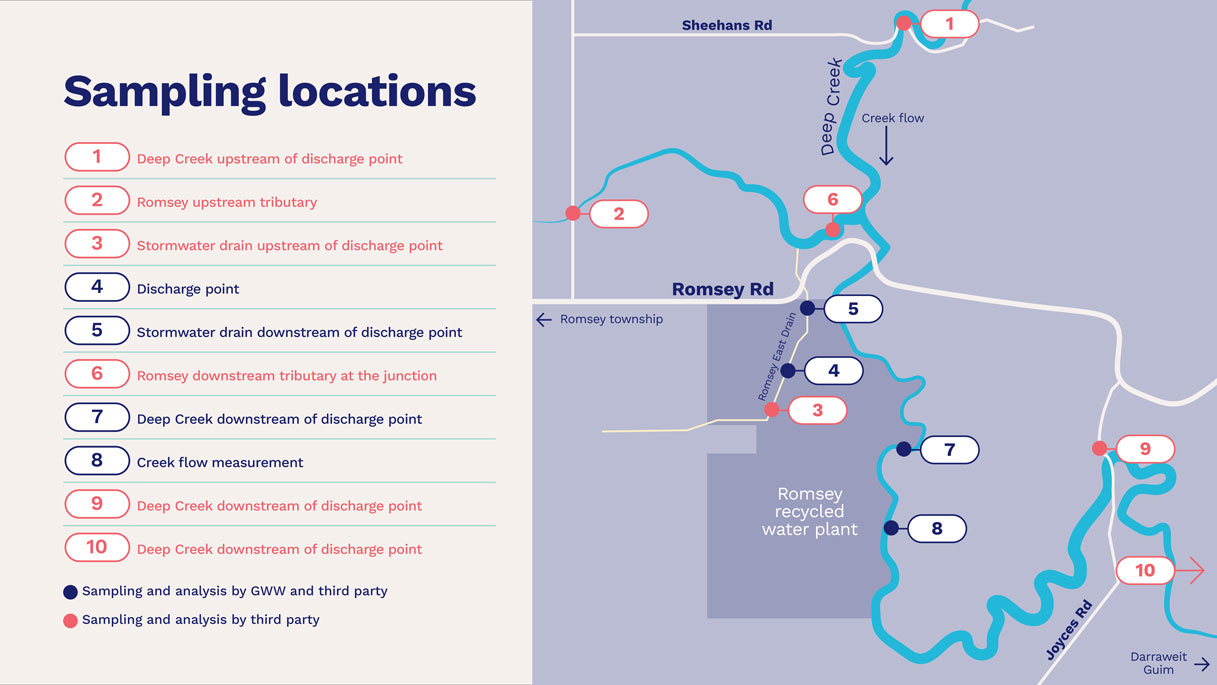
The Romsey Deep Creek sampling locations
FAQs
Expand all
This is a broad term for microscopic organisms that can cause illness in humans and animals. Pathogens are ever-present in the environment, including in normal creek flows and recycled water. However, only a small number of specific pathogens can cause illness.
GWW monitors for potentially harmful pathogens in our recycled water, including E. coli, which is usually harmless but can cause gastroenteritis, and helminths, which are parasitic worms that can infect humans and animals. Helminths have never been detected at the Romsey Recycled Water Plant. For discharge, E. coli levels are checked daily to ensure disinfection measures are working.
Helminths are parasitic worms that can infect humans and other animals. For helminth removal, we comply with the Chief Veterinary Officer’s approved method of removal of at least 25 days lagoon detention, as per Victorian guideline for water recycling (EPA Victoria).
The minimum detention time (at lowest operating level) for secondary treated effluent in the plant is 65 days. When operating at full capacity, a detention time of 155 days is achieved. See also Chief Veterinary Officer - Purification Standards for Night–Soil and Sewage (Victorian Government Gazette, S237 25 Sep 2007).
In addition, we add chlorine and ultraviolet disinfection to the plant to increase pathogen removal, as an additional barrier for bacteria, virus and protozoa treatment.
No, the water that is being released into Deep Creek is treated Class B recycled water, which is suitable for a range of uses.
This recycled water release is necessary to avoid a spill of sewage into the environment and damage to the Romsey Recycled Water Plant (RWP). We are temporarily releasing controlled amounts of recycled water into the waterway to help reduce the amount we are holding in storage to a safe level.
Class B recycled water is a high grade of recycled water suitable for sheep, goats, cattle, horses and poultry drinking water. It’s not suitable for pigs to drink.
Class B recycled water is acceptable for a number of uses, including for certain human food crops, livestock grazing and fodder and irrigation of public spaces such as sporting ovals and golf courses.
Many things impact Deep Creek’s water quality. Urban stormwater and agricultural runoff pick up pollutants such as oil, dirt, chemicals and bacteria as it makes its way into the waterway.
Occasionally, foam appears in waterways after heavy rain when the water’s flow rate is high. Recycled water can cause some foaming along with other runoff into the creek. This is short term and will fade as the flow reduces
We are releasing at times when there are adequate flows in the creek for the release to meet the mixing zone requirements, as determined by an independent water quality modelling. While for most parameters, the quality of our recycled water is similar to or better than levels in Deep Creek and does not need a mixing zone, our water can contain higher levels of nutrients (nitrogen and phosphorus).
Independent studies for this recycled water release show nutrient dilution will be completed within 3 kilometres downstream of the recycled water discharge point, where the water returns to comparative quality as the water before our discharge point. We are sharing the details of each release on this page.
We’ve been doing everything we can to reduce onsite volumes at Romsey Recycled Water Plant. We’re implementing extra measures to manage onsite volumes including maximising temporary storage and undertaking major works to increase permanent storage ability.
We also use recycled water to irrigate farmland around the plant. We’ve almost doubled the land under irrigation since 2020, allowing us to apply more water for beneficial use, and will be adding further irrigation capacity as part of our major plant upgrade. We sell recycled water to local irrigation customers, too.
An accredited independent laboratory is sampling and testing multiple times a week at several monitoring points within the Romsey RWP and along Deep Creek to assess any changes.
Our internal laboratory is also testing daily water samples from several points at the Romsey RWP to monitor the plant’s performance and ensure the recycled water we release into Deep Creek meets Class B standards.
We are testing for a range of things that tell us the water is meeting the required standard, including pH level, nutrients and E.coli. The independent laboratory results are available on this page.
We are upgrading the Romsey Recycled Water Plant, including increased storage to support the region’s growing population. This work is informed by master planning undertaken in conjunction with independent consultants. Planning has been completed with next steps to include detailed design and community engagement. Construction is scheduled to commence in 2027, with preparatory works already underway.
Heavy rainfall, flooding and stormwater runoff all have an impact on waterway quality. To protect your health, assume all floodwaters are contaminated.
When deciding whether a waterway is suitable for swimming, EPA Victoria recommends to always check for signs of pollution. Pollution can look like stormwater drains flowing, murky water, bad smell and rubbish.
We publish water quality sampling results for recycled water releases from the Romsey Recycled Water Plant on this page, along with upstream and downstream sampling points for comparison. This testing includes E.coli, which is a bacteria found in faeces and the best indicator for measuring pollution from faecal contamination.
Here’s some useful information from EPA Victoria:
Previous testing results
Expand all
Update - 27 October 2023
The release of recycled water from the Romsey Recycled Water Plant (RWP) into Deep Creek has ended.
This controlled release was a last resort decision which has allowed us to maintain a safe storage level at the plant during the wetter months, and ensured that the risk of harm to human health and the environment were minimised as far as reasonably practicable. With warmer days forecast and the farmland surrounding the RWP now starting to dry out, we expect to commence local irrigation in the coming weeks.
We know maintaining the health of Deep Creek is important to the community and we share those values. The release has been conducted in a highly controlled manner to safeguard the health of the environment and community.
Read our full statement Emergency controlled release from Romsey Recycled Water Plant.
Water quality results
The table below shows the quality of recycled water released from Romsey Recycled Water Plant (sampling point 3).
How to read our sampling and testing report
We use a risk-based approach to track the performance of the Romsey Recycled Water Plant. This determines how often we sample and test the water quality.
Green = Pass Class B
Results meet the EPA guidelines for Class B recycled water.
Orange = does not meet Class B (E. coli) guidelines
Results do not meet Class B guidelines for E. coli. If E. coli results exceed 400 org/100ml on two consecutive occasions, we are required to stop releasing the water and take additional measures to improve water quality.
Red = Fail Class B
Results do not meet Class B guidelines. GWW will pause the release and take additional measures to improve water quality.
| Date of release | 4-8 October | 9-15 October | 16-23 October | 23-30 October |
| Test | Results | Results | Results | Results |
| pH | Pass (Class B) - Levels are between 6 - 9 |
Pass (Class B) - Levels are between 6 - 9 |
Pass (Class B) - Levels are between 6 - 9 |
Pass (Class B) - Levels are between 6 - 9 |
| Suspended solids | Pass (Class B) - Levels are under 30 mg/L | Pass (Class B) - Levels are under 30 mg/L | Pass (Class B) - Levels are under 30 mg/L | Pass (Class B) - Levels are under 30 mg/L |
| E. coli | Pass (Class B) - Levels are under 100 org per 100ml | Pass (Class B) - Levels are under 100 org per 100ml | Pass (Class B) - Levels are under 100 org per 100ml | Pass (Class B) - Levels are under 100 org per 100ml |
| Biological Oxygen Demand | Pass (Class B) – Levels are under 20 mg/L | Pass (Class B) – Levels are under 20 mg/L | Pass (Class B) – Levels are under 20 mg/L | Pass (Class B) – Levels are under 20 mg/L |
The release of recycled water into Deep Creek was completed on 24 October 2023.
Data from all sampling points and information about how much recycled water was released: