News article

Partnering on science to better understand algae blooms
17 August 2026
This National Science Week, Greater Western Water is celebrating science with a real-world purpose: helping protect the water our customers and communities rely on.
GWW is working with Victoria University and PhD student Laryssa on research into harmful cyanobacterial blooms, also known as blue-green algae, and how the water industry can better predict, manage and respond to them.
The partnership brings together Victoria University’s research expertise and GWW’s operational experience, using real water, data and industry scenarios to explore practical solutions.
“My PhD focuses on harmful cyanobacterial blooms and how we can better manage the challenges they create for the water industry,” said Laryssa.
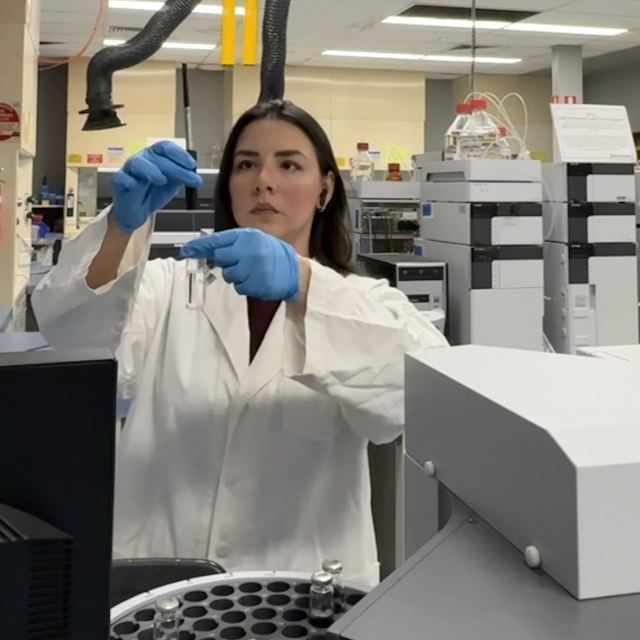
Laryssa in the lab recently
“I’m looking at different parts of the problem, from understanding and predicting bloom events to treating affected water and finding better ways to manage the biomass produced during blooms.”
Blue-green algae blooms can affect water quality in several ways. Some species can produce toxins, while blooms can also cause taste and odour issues and create challenges for water treatment and recycled water systems.
As climate and environmental conditions become more favourable for bloom formation, understanding how to respond is becoming increasingly important. “One of the challenges with cyanobacterial blooms is that there is no single solution,” said Laryssa.
“Ultimately, the goal is to provide more options for managing blooms and reducing their impacts when they occur.”
Because the research is being developed in partnership with GWW, it can focus on questions directly relevant to water utilities and the communities they serve.
“The aim is for the research to provide practical information and tools that could support bloom monitoring and early warning, improve treatment options for bloom-affected water, and help identify better ways of managing cyanobacterial biomass,” said Laryssa.
“Working directly with GWW also allows us to test the research using real water, operational data and real-world scenarios.”
For Laryssa, the project has also highlighted how broad science careers in the water industry can be.
“There are opportunities for people from many different backgrounds, including biology, chemistry, environmental science, engineering and data science.”
“There are so many different scientific questions involved in managing water, and the work can have a very direct impact on communities and the environment.”
This National Science Week, GWW is proud to celebrate the people and partnerships shaping smarter, more sustainable water solutions.